
AI-CCORE Blogs
AI-CCORE: AI Exhibit Goes Off-Campus to Afro Fest Omaha
On Sept. 5, six graduate students, student workers, and staff from the University of Nebraska at Omaha deployed the AI-CCORE exhibit at Afro Fest Omaha. Across five live stations and a dedicated mobile portal, the five-hour off-campus activation drew hundreds of hands-on visitors and logged 1,512 digital interactions over the festival weekend.
The exhibit lives on campus. AI-CCORE (Artificial Intelligence Center for Collaborative Outreach, Research, and Education), the applied AI hub at the University of Nebraska at Omaha (UNO), stores it at the Barbara Weitz Community Engagement Center (CEC), where it ran indoors on March 25 for Mav AI Day and where it will be featured again in upcoming campus exhibitions.
On Sept. 5, the exhibit moved off campus for the first time, traveling to Afro Fest Omaha for a five-hour outdoor deployment. Six graduate students, student workers, and staff operated five live stations while visitors moved through demonstrations, asked questions, and tried the systems themselves.
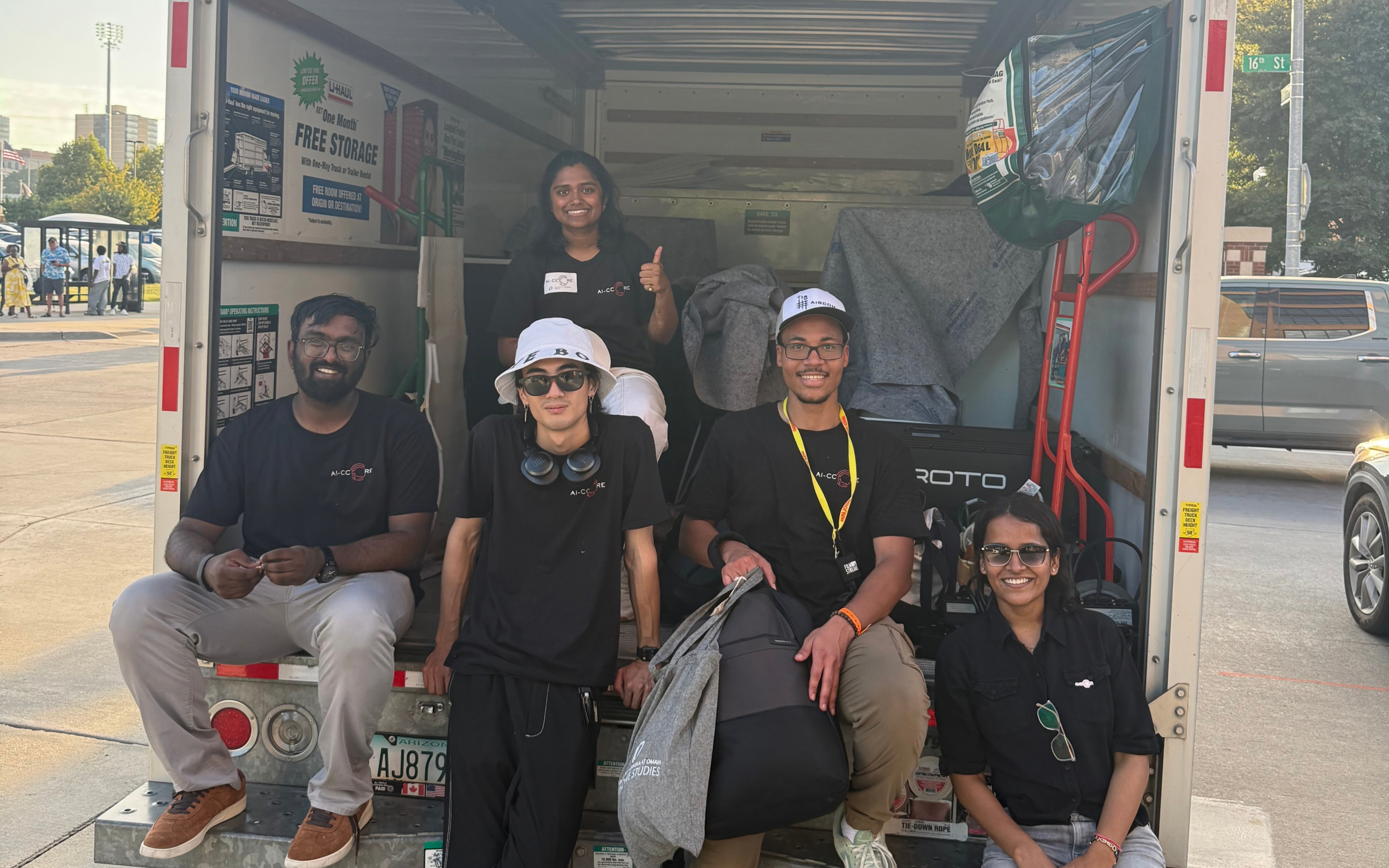
Loading our from the CEC
Afro Fest Omaha was the first time the whole kit left campus. It was the center’s first major public event beyond university walls, and the first field test of the off-campus exhibit experience that NA’WI (Nebraska AI Literacy and Workforce Infrastructure) will carry across rural Nebraska.
A six-person team of full-time staff, graduate assistants, and student workers loaded a 15-foot U-Haul at the CEC on Friday afternoon, after the center’s Afro Tech Day session. The loaded truck stayed securely staged overnight.
Setting up in the Innovation Zone
The truck pulled in behind Sonny’s, an outdoor venue in Omaha’s Builders District, at noon on Saturday, Sept. 5. The team rolled road cases, monitors, and workstations across the turf toward an open canopy in the Innovation Zone at Afro Fest Omaha, hosted by AfrOmaha and the House of Bah Foundation.
Every station was staged, powered, and running by 1 P.M. The team set out to learn two things: how well the exhibit travels, and how festivalgoers respond when they can try AI for themselves. By the end of the weekend, that engagement reached beyond the canopy, generating 1,512 digital interactions across the companion portal and walking tour.
Five stations under one canopy
Each station ran live technology visitors could touch, not slides. Staff stayed at the tables all afternoon, so anyone could walk up, ask a question, and try the equipment without booking anything in advance.
Station 1 · Proto holographic display
A recorded briefing from Chancellor Joanne Li played at life size on a transparent backlit LCD unit. No headset was needed, which made it the one station a whole group could stand at together.

Station 2 · Reachy Mini companion robotics
Seven Pollen Robotics tabletop units were programmed to synchronize movement and sound with West African Lamban percussion rhythms. The robots sit at table height, so visitors leaned in close and stayed to see how the units followed them.

Station 3 · Virtual reality (VR) cultural exploration
Headsets carried immersive 3D environments spanning the Pyramids of Giza, the Serengeti, and tech hubs in Kigali, with a screen beside the table so people waiting could follow along.

Station 4 · Artist's Lens AI storytelling kiosk
The kiosk ran an on-device generative vision pipeline. OpenCV and a ResNet-50 model read face and pose from a live portrait, and a ControlNet-conditioned latent diffusion model turned it into a stylized portrait or a four-panel comic strip. Nothing left the workstation.

Station 5 · Hekima walking tour and mobile portal
The exhibit reached past the canopy. A seven-stop Hekima walking tour ran from 16th Street into Sonny's Builders District, each stop paired with the companion mobile portal: narrated folk stories, cultural history, and an interactive guide that visitors followed on their own phones.

The questions changed by mid-afternoon
Staff at the tables noticed the questions shift while it was happening. Early in the day people asked about the objects in front of them. By late afternoon they were asking about use: small business owners wanted to know where the images are processed, and educators asked what it would take to run the modules in a classroom without the hardware in the room.
Several hundred festival attendees, local business owners, and community leaders came through the canopy. The team handed out more than 100 program flyers across the center's four active offerings: Applied AI Bootcamps, Strategic AI Masterclasses, the NextGen AI Studio, and NA'WI.
Running on festival power
Indoors, the exhibit runs on campus power and the campus network. At Sonny's it ran on venue drop cords, two power strips, and a single dedicated mobile hotspot that stayed at the station for the entire run. Power and network both held: five continuous hours, 1 - 6 P.M., with no interruption on either.
The canopy layout was planned around the afternoon sun. The team angled the stations so no display faced direct light, and the two large retractable banners along the tent perimeter doubled as shade barriers across the workstations and screens. The tent also sat a comfortable distance from both festival stages, so ambient music never competed with the demonstrations.

What the first off-campus run showed
A six-person team can stage, power, and operate the full exhibit outdoors for five hours on venue drop cords and one mobile hotspot. Every piece arrived and returned ready to run, and the exhibit drew steady hands-on use from an audience that had come for a music festival.
Folly Teko, Founder of AfrOmaha, was delighted with the heavy community turnout at the tent. He noted how popular the AI-CCORE exhibit was throughout the afternoon, with the Innovation Zone steadily crowded from opening through the close of the day.
Ashley Yemima Gadjoro, Founder and Executive Director of the House of Bah Foundation, said the response to the Innovation Zone was strong. She pointed to the companion robots and the VR headsets as the two stations that made new technology approachable for visitors who had not come expecting a university demonstration.
Where the Exhibit Goes Next
The off-campus exhibit experience is now the operational model for NA'WI. The same stations travel as mobile AI kits, Proto holographic instruction, and companion robotics to community colleges, public libraries, and Nebraska Extension offices across rural Nebraska, including the Panhandle, the Sandhills, South-Central, and the Northeast.
Each stop is built to be practical and zero barrier: no software to buy, no account to create, and no technical background required. Producers, rural clinics, and Main Street businesses can each see the tools working on their own kind of problem, and every stop connects to the center's multi-week studios and bootcamps.
-1-400x300.png)
Thanks and partnerships
Thank you to AfrOmaha and the House of Bah Foundation for the invitation and the welcome. AI-CCORE brings working hardware and applied AI demonstrations to cultural, civic, and industry gatherings across Nebraska, and the outreach team is taking requests for the next round of sites.
Contact [email protected] to schedule a visit or discuss an exhibit partnership.
